guides
Emergency Water Storage: The 2-Week Supply Every Home Should Have
One gallon per person per day, 14 days, stored right — the honest guide to emergency water: containers ranked by budget, rotation, treatment, and the myths that waste money.
Honest disclosure: Some links below are affiliate links — Glivox earns a commission if you purchase, at no extra cost to you. We pay full price for products we review and rankings are never paid. Read the full policy.
Of all the preparedness projects a household can take on, water storage is the strange one: it’s the most important, the cheapest, and the least done. A burst main, a flood advisory, a grid failure at the pumping station — “no tap water for a few days” is among the most common emergencies there is, and the fix costs less than a family pizza night.
This is the honest guide, free of both panic and gadget-selling: how much water actually matters, the container options ranked by real budget, where to keep it, the rotation schedule nobody follows (and the one they will), and what the bigger off-grid water projects add later if you want them.
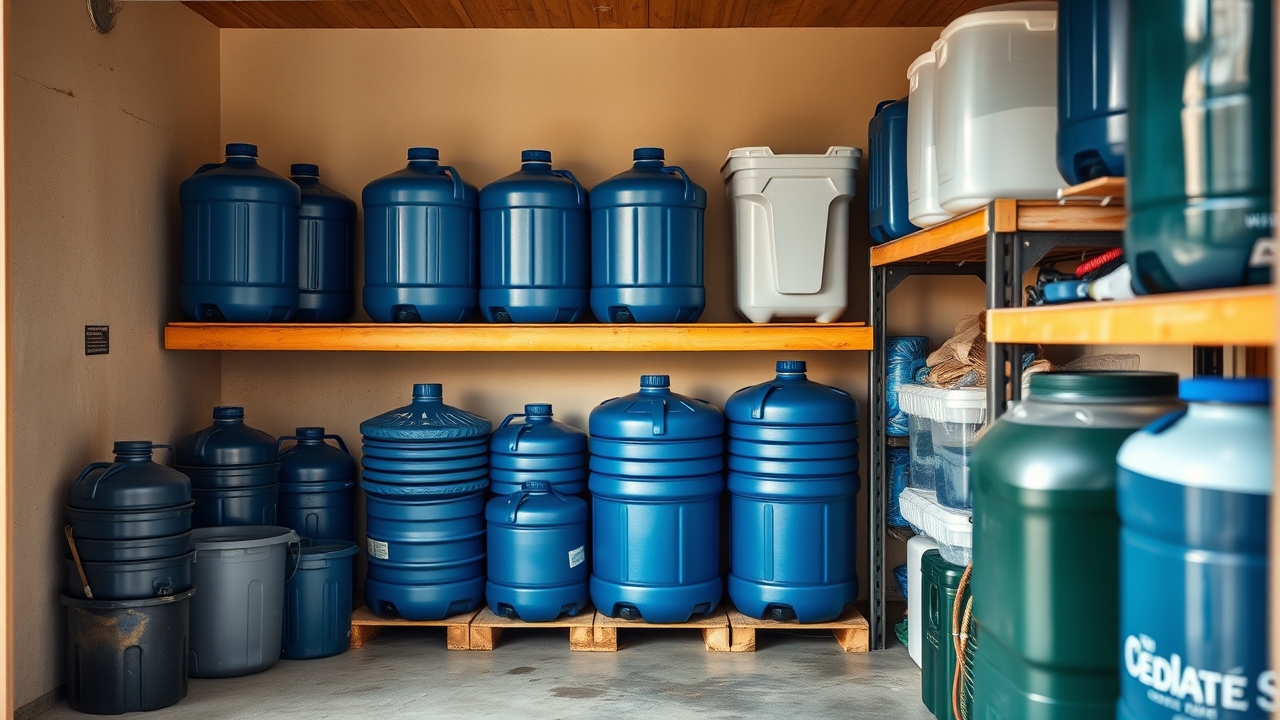
TL;DR — the target and the shortcut
The standard: 1 gallon (≈4 liters) per person per day — half for drinking, half for minimal cooking and hygiene — and the honest minimum worth building is two weeks, not the old 3-day advice (most real water disruptions outlast a weekend). Family of four: 56 gallons. The budget path: a few cases of bottled water for grab-and-go, plus stackable 5–7 gallon jugs or a couple of water-safe barrels for the bulk, filled from the tap, six drops of unscented bleach per gallon only if your source water is questionable (municipal tap water stores fine as-is), stored dark and cool, refreshed yearly. Add one quality filter (gravity or squeeze type) and every doubtful gallon — stored, found, or harvested rain — becomes usable too. Total for a family: roughly $50–150 once, then almost nothing forever.
Buy it if
two weeks of stored tap water in food-grade containers + one real filter — the highest ROI preparedness money there is
Skip it if
survival-store 'water pods' and miracle purifier gadgets at 10x the price of a barrel and bleach — the boring solution IS the professional solution
Try instead
Zero storage space? Even 3 cases of bottled water under a bed beats the national average, and a bathtub liner bag adds 65-100 gallons on demand
How much water, honestly
The 1-gallon-per-person-day figure covers drinking (about half) plus minimal cooking and hygiene — it does not cover showers, laundry, or flushing on demand. Real planning notes that change the math: hot climates and physical work can double drinking needs; children, nursing mothers, and the ill need more; pets count (a large dog ≈ a person’s drinking share); and cooking from storage (rice, beans, your preserved garden) uses more water than takeout-normal life.
Two weeks is the honest baseline because the common failure modes — boil-water advisories, main breaks, storm outages — run days to a week+, and the inconvenient truth of every regional disaster report is that help concentrates on day 3–7, not hour one. Build 14 days; grow toward a month if space allows.
56 gal
Two weeks for a family of four at 1 gal/person/day - about three stacked 20-gal containers, or one barrel and change
Containers, ranked by budget (and honesty about each)
Tier 1 — Bottled water cases ($15–25 for a week’s drinking). Zero effort, long shelf life, portable, and the right answer for evacuation bags. Weakness: bulk drinking-only coverage gets expensive and wasteful past a week. Every plan should include some; no plan should be only this.
Tier 2 — Stackable 5–7 gal jugs ($15–25 each, the sweet spot). Food-grade (HDPE, usually blue), light enough to carry when full, stack two-three high, fit closets. Six or eight of these = a family’s two weeks, bought over two months of grocery runs. This is the tier most households should build first.
Tier 3 — 15–55 gal barrels ($60–120 new). The volume champion: one 55-gal barrel ≈ a family’s two weeks in one footprint. Caveats stated honestly: a full 55-gal barrel weighs ~200 kg (place it before filling, on a stand or plywood — never directly on bare concrete, which can leach and temperature-cycle), you’ll need a hand pump or spigot bung ($10–20) to get water out, and it’s immobile — barrels store, jugs move.
Tier 4 — The freebie layer. Washed 2-liter soda bottles (PET, fine for water) filled with tap water cost nothing and tuck into every dead space; the bathtub liner bag (~$25–35) turns a tub into 65–100 sealed gallons if filled before the water stops — a warning-time tool, not a baseline. What to skip: old milk jugs (degrade, never truly clean) and any container that previously held chemicals — “food-grade” is the entire spec.
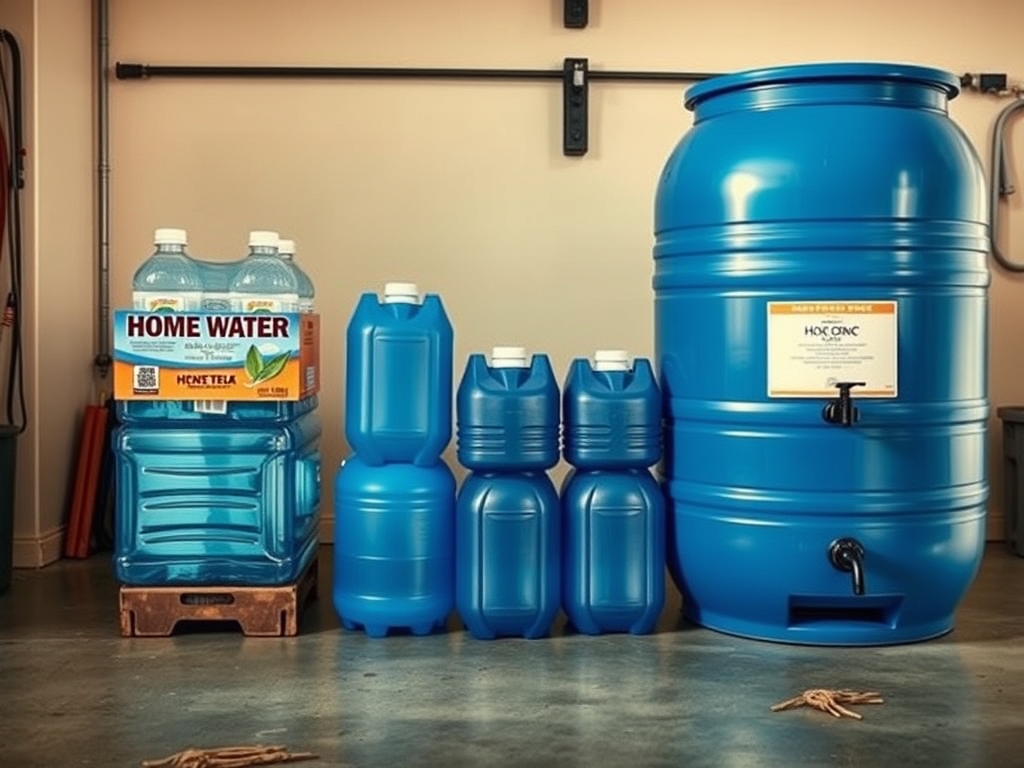
Filling, treating, and the rotation nobody does
Filling: municipal tap water is already disinfected — fill clean containers and seal; nothing else required. Well or questionable water: add unscented household bleach (6% sodium hypochlorite), 6–8 drops per gallon, or fill and plan to treat at use instead.
Storage conditions: cool, dark, off bare concrete, away from fuel and chemicals (plastic breathes vapors over years). Light + warmth don’t make stored water “toxic” — they grow algae in clear containers and age plastic; opaque containers in a dark corner sidestep all of it.
Rotation, honestly: the textbook says every 6–12 months. The realistic version that actually happens: tie it to one existing yearly ritual — the day you change smoke-alarm batteries, first day of spring, tax day — dump stored water on the garden, refill, done in 20 minutes. And know the safety net: properly stored water doesn’t spoil like food — stale-tasting old water is almost always safe, fixed by pouring between containers to re-aerate, or treated at use. The rotation is for quality; the filter below is the real safety layer.
The use-time layer: one gravity or squeeze filter (the backpacking standbys, $25–100) covers the “is this still good?” doubt on any stored, harvested, or found water — plus boiling remains the free, always-works fallback. Storage + filter + bleach knowledge = a complete household water system for under $150. (Water is half of basic readiness — the two-week food pantry is the other half.)
Quick wins vs. money-wasters
What works
- Build Tier 2 first: six stackable jugs, two per grocery trip
- Tie rotation to an existing yearly ritual - old water feeds the garden
- One real filter covers stored + rain + doubtful water at use-time
- Bathtub liner bag as the warning-time multiplier (fill BEFORE the outage)
What doesn't
- Milk jugs and chemical containers ("free" storage that fails/contaminates)
- Clear containers in daylight (algae farm by month three)
- Overpriced survival-store water gadgets doing what bleach + barrel do
- Stopping at 3 days because an old checklist said so
FAQ
How much water should I store for an emergency?
One gallon (about 4 liters) per person per day — half drinking, half cooking and minimal hygiene — for a minimum of two weeks: 56 gallons for a family of four. Scale up for hot climates, heavy work, children, the ill, and pets (a large dog counts like a person’s drinking share). The old 3-day guidance is outdated: common disruptions — boil advisories, main breaks, storm outages — routinely run longer, and two weeks is the standard modern preparedness agencies actually recommend.
How long can you store tap water for emergencies?
Indefinitely, from a safety standpoint, if stored properly: clean food-grade containers, sealed, kept cool and dark. Municipal tap water is already disinfected and needs no additives at filling. Water doesn’t expire like food — old stored water may taste flat (fixed by pouring it between containers to re-aerate) but is almost always safe. Best practice is still a yearly refresh for quality, and a use-time backstop (a quality filter, or boiling) covers any doubt.
What is the best container for storing emergency water?
For most households: stackable 5–7 gallon food-grade jugs — light enough to carry, stackable in a closet, ~$20 each, and a family’s two-week supply fits in six to eight of them. Bottled water cases handle the grab-and-go layer; a 55-gallon barrel is the cheapest per-gallon bulk (place it before filling — 200 kg full — and buy the $15 hand pump); washed 2-liter soda bottles are the free filler layer. Avoid milk jugs and anything that ever held chemicals — food-grade is non-negotiable.
Should I add bleach to stored water?
Only if the source water is untreated or questionable. Municipal tap water is already chlorinated — fill clean containers, seal, done. For well water or uncertain sources: 6–8 drops of plain unscented household bleach (6% sodium hypochlorite) per gallon, mixed and left 30 minutes. Bleach itself loses potency within a year of purchase, so date the bottle. And keep the always-works fallbacks in mind: a rolling one-minute boil, or a quality gravity/squeeze filter at use-time, cover every doubt storage can’t.
Glivox publishes practical, honest guides for homesteaders and backyard growers — the boring solution is the professional solution.
Keep reading
guides
Off-Grid Water Systems for Homesteads: A Realistic 2026 Guide
Rainwater, wells, springs, and air-to-water: the real off-grid homestead water options for 2026 — what each costs, delivers, and where they oversell.
guides
Root Cellar Without a Cellar: Store Months of Food With No Basement
No basement, no problem. Garage corners, buried barrels, sand boxes and in-ground trenches — honest ways to store potatoes, carrots, squash and apples for months.
guides
Rainwater Harvesting Basics: From First Barrel to Real Storage
Your roof already collects thousands of gallons a year — you're just not keeping any. The honest starter guide: parts, real math, costs, and the mistakes that breed mosquitoes.