guides
Planting Fruit Trees in Fall: Why October Beats April (and How to Do It Right)
Fall-planted fruit trees grow roots all winter and outrun spring plantings for years. Site rules, the $20 bare-root secret, the planting-hole method, and the first-year honesty.
Honest disclosure: Some links below are affiliate links — Glivox earns a commission if you purchase, at no extra cost to you. We pay full price for products we review and rankings are never paid. Read the full policy.
Everyone plants fruit trees in spring — garden centers stack them by the door in April and the crowds oblige. Meanwhile, orchardists and extension services keep repeating advice almost nobody takes: in most climates, fall is the better planting season. A tree planted in October spends all winter doing the only job that matters in year one — growing roots into cool, moist soil with zero heat stress — and greets its first spring already established, while the April-planted tree next door is still recovering from transplant and facing summer with a starter root system.
Like garlic, it’s a fall-only opportunity with a real deadline; unlike garlic, this one is a 20-year decision, so the hour of thinking before the hole matters more than the hole. Here’s the honest sequence: whether fall works in your climate, the site test that outranks variety choice, the bare-root money trick, and the planting method that avoids the three classic tree-killing mistakes.
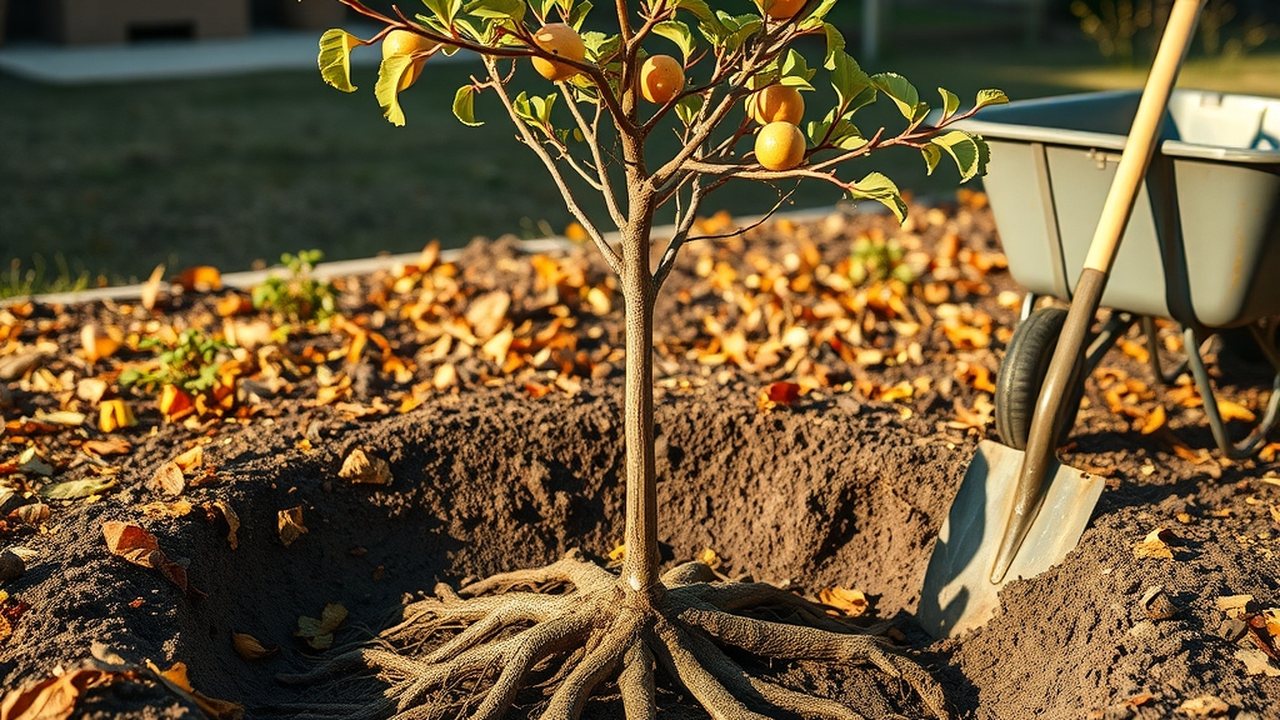
First: does fall planting fit your climate?
The rule: fall planting wins wherever the tree gets ~6 weeks of root-growing time before the ground freezes — roots keep working in soil above ~5°C long after the leaves quit. That covers most temperate regions (plant September–November, after summer heat breaks). The honest exceptions: brutal-winter zones (roughly USDA 4 and colder) where spring is safer for anything marginal, and stone fruits in cold regions — peaches, nectarines, apricots are tender enough that spring planting is the conservative call. Apples, pears and plums are the classic fall-happy crew almost everywhere else, and in mild-winter climates fall isn’t just better — it’s the main season, exactly the fall-is-the-easy-semester logic scaled up to trees.
~6 weeks
Root-growing time a fall-planted tree needs before the ground freezes - the whole go/no-go test for your climate and date
The hour that matters more than the hole
A fruit tree is a 20-year tenant; the site interview is everything:
- Sun: 6–8 hours minimum. Fruit is made of sunlight; a shaded fruit tree is an ornamental with extra steps.
- Drainage is the veto. Trees drown slowly in winter-wet ground. Test: dig a 30 cm hole, fill with water, refill next day and time it — draining under ~4 hours is fine; standing water into the next day is a veto (or a mound-planting site).
- Space for the adult, not the sapling: dwarf trees want ~3 m circles, semi-dwarf 4–5 m — measured from buildings, fences and each other. Every crowded orchard was planted by someone who saw whips, not trees.
- Pollination homework (5 minutes that decides whether you ever get fruit): many apples, pears and plums need a different compatible variety blooming nearby. Self-fertile picks (most peaches, sour cherries, some plums and apples) sidestep it; otherwise plant partners, or confirm neighborhood trees exist.
- Variety by chill-hours and disease pressure: buy from a regional nursery and this solves itself — their catalog is the filter. Big-box trees are how the wrong climate’s varieties end up sulking in your yard.
The bare-root secret (fall and late-winter’s money trick)
Trees sell two ways: potted ($40–80+, available all year, heavier, sometimes root-bound from circling in the pot) and bare-root — dug dormant, shipped with naked roots, planted in fall or very early spring, typically $20–40, with a wider natural root spread and a better long-term structure than the same money in a pot. Regional nurseries open bare-root ordering in late summer and fall; like seed garlic, the good varieties sell through early. If your area’s ordering window is open now, this is the week to browse.
(Bare-root logistics, honestly: plant within days of arrival, soak roots a few hours first, and never let them dry out in between — their one weakness is impatience.)
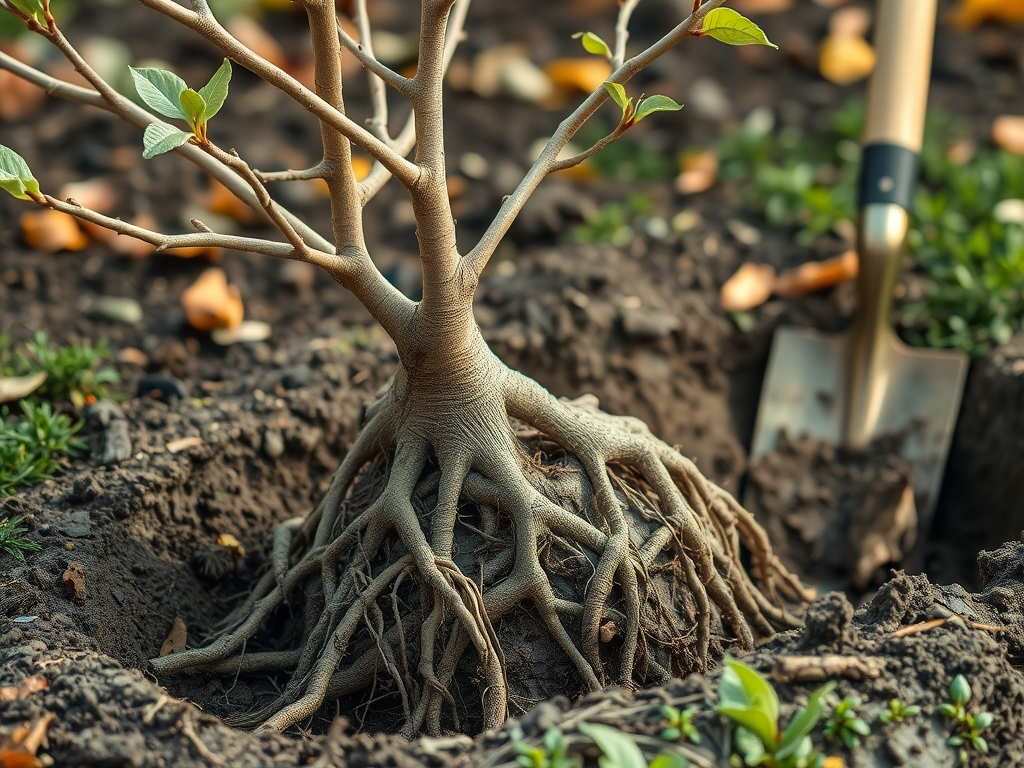
Planting day (the method, and the three classic killers)
- Dig wide, not deep — a saucer 2–3× the root spread across but only as deep as the roots. Rough up the sides. Wide-and-shallow beats deep-and-narrow because feeder roots live in the top layers.
- Killer #1 — planting too deep. Find the root flare (where trunk widens into roots) and keep it at or slightly above ground level; on grafted trees the graft union stays a hand-width above soil. Buried flares rot bark and stall trees for years — the most common fatal mistake in home orchards.
- Backfill with the native soil you dug out — not a luxury pit of compost. Killer #2 — the amended hole: roots circle in the rich pocket instead of venturing into real soil, “flower-pot” style. Save the compost for the surface.
- Water in thoroughly to settle soil around roots (this matters more than any fertilizer — and skip fertilizer entirely at fall planting; you don’t want tender new top-growth meeting winter. Feeding starts next spring).
- Mulch a 1 m donut, 8–10 cm deep — with a bare gap at the trunk. Killer #3 — the mulch volcano: mulch piled against bark holds moisture on the trunk and invites rot and rodents. Donut, never volcano. (Your fall-cleanup leaves are exactly the right material.)
- Stake only if your site is windy (loose figure-8 tie, removed after a year — trunks strengthen by flexing), and in rabbit/vole country, add a trunk guard now: winter bark-gnawing kills more young trees than winter cold.
Then — the fall-planting punchline — you’re done. No pruning to speak of, no feeding, no summer watering vigil. Water deeply every couple of weeks until the ground freezes if rain fails, and let winter do the establishment.
Year-one honesty (so spring doesn’t scare you)
A fall-planted tree leafs out in spring looking unremarkable — that’s normal; the progress happened underground. Water it through its first summer dry spells (the one real obligation of year one), keep the mulch donut renewed, and expect first meaningful fruit in year 2–4 for dwarf trees, 3–5 for semi-dwarf — patience that sounds long until you remember every year you don’t plant moves the harvest a year further away. Pinch off any fruit that sets the first spring; the tree needs roots more than it needs to prove itself.
What works
- Fall = a winter of root growth before the first summer test
- Bare-root from a regional nursery: cheaper, better roots, right varieties
- Root flare AT soil level, native-soil backfill, mulch DONUT
- Drainage test and pollination homework before any hole is dug
What doesn't
- Planting depth by eye (buried flares stall trees for years)
- The compost-filled luxury hole (roots never leave the pot you dug)
- Mulch volcanoes against the trunk (rot + rodent cover)
- Fall-feeding a new tree (tender growth walking into winter)
FAQ
Is fall a good time to plant fruit trees?
In most temperate climates, it’s the best time: a tree planted in September–November grows roots all winter in cool moist soil (roots work above ~5°C long after leaf-drop), faces no heat or drought stress while establishing, and enters its first summer far ahead of a spring-planted tree. The test is roughly six weeks of unfrozen ground after planting. Exceptions: very cold zones (USDA ~4 and below) and tender stone fruits like peaches in cold regions, where spring is the safer call.
What is a bare-root fruit tree, and is it better than a potted one?
Bare-root trees are dug and shipped dormant with no pot or soil, planted in fall or very early spring. For the same money they’re typically larger-rooted, cheaper ($20–40 vs $40–80+), never pot-circled, and establish with a more natural root spread — which is why orchardists overwhelmingly plant bare-root. The trade-offs: a narrow planting window, and roots that must never dry out (plant within days, soak before planting). Order from regional nurseries in late summer/fall; popular varieties sell out early.
How deep should you plant a fruit tree?
Shallower than instinct says: dig the hole two to three times wider than the root spread but only as deep as the roots, and set the tree so the root flare — where the trunk widens into the root system — sits at or slightly above the finished soil level, with any graft union a hand-width above ground. Planting too deep is the most common fatal mistake in home orchards; buried bark rots and trees stall for years. Backfill with the native soil, water in well, and put compost on top, not in the hole.
How long until a fruit tree produces fruit?
Realistic timelines by size: dwarf trees typically bear meaningful fruit in years 2–4, semi-dwarf in 3–5, full-size standards in 5–8 — with pears on the patient end and some plums and peaches on the quick end. Fall planting shaves the establishment lag but doesn’t change the biology. Two habits speed quality fruit later: remove any fruit that sets the first year (roots first), and get pollination right from day one — a lonely self-sterile tree bears nothing on any timeline.
A fruit tree’s best planting day was five years ago; its second-best is an afternoon this October.
Keep reading
guides
Fall Garden Cleanup: What to Remove, What to Leave (Most People Clean Too Much)
The honest fall checklist: pull the diseased and the pest hotels, leave the roots and the leaves — why a too-tidy garden costs you soil, pollinators, and next spring's head start.
guides
How to Plant Garlic in Fall: The 20-Minute Job That Feeds You Next July
Plant cloves in October, ignore them all winter, harvest heads in summer — the honest garlic guide: hardneck vs softneck, seed garlic vs grocery bulbs, spacing, and the one mistake that ruins it.
guides
Apple Harvest and Storage: The Lift-and-Twist Test, and Months of Crisp Fruit
When an apple is truly ready, which varieties keep until spring, and the storage rules — cold, humid, and quarantined — that stop one bad apple from proving the proverb.