guides
Curing and Storing Onions: From Flopped Tops to a Braid on the Wall
When onion tops flop, the clock starts — the 2-3 week cure, the papery-neck test, the honest truth about sweet onions, and how to braid a year's supply onto one nail.
Honest disclosure: Some links below are affiliate links — Glivox earns a commission if you purchase, at no extra cost to you. We pay full price for products we review and rankings are never paid. Read the full policy.
An onion announces its own harvest more clearly than any crop in the garden: one week in late summer, the tall green tops simply fall over at the neck, row by row, like the plants collectively clocking out. That flop is the signal — bulbing is finished, the plant is done investing, and the clock starts on the one process that decides whether your onions last three weeks or eight months: the cure.
Onions are garlic’s close cousin in this — same family, same logic: the harvest is easy, and the keeping is won in the two unglamorous weeks right after it. Here’s the honest sequence, including the sweet-onion truth most guides soften, and the braid — the storage method that’s also the best-looking thing in the pantry.
The flop, and the week after
When roughly half to three-quarters of the tops have fallen over on their own, stop watering and give the bulbs one more week in the ground — skins thicken, necks begin to close. (Don’t bend the tops over yourself to hurry it; the old trick bruises necks and invites rot into exactly the spot you need sealed.)
Then lift on a dry day: loosen with a fork and pull gently by the bulb, not the withering top. Shake off soil — don’t wash (the universal storage-crop rule) — and if the weather’s dry, let them lie right on the bed for a day or two, tops on, roots on, getting their first air-dry where they grew.
The cure: two to three weeks of organized ignoring
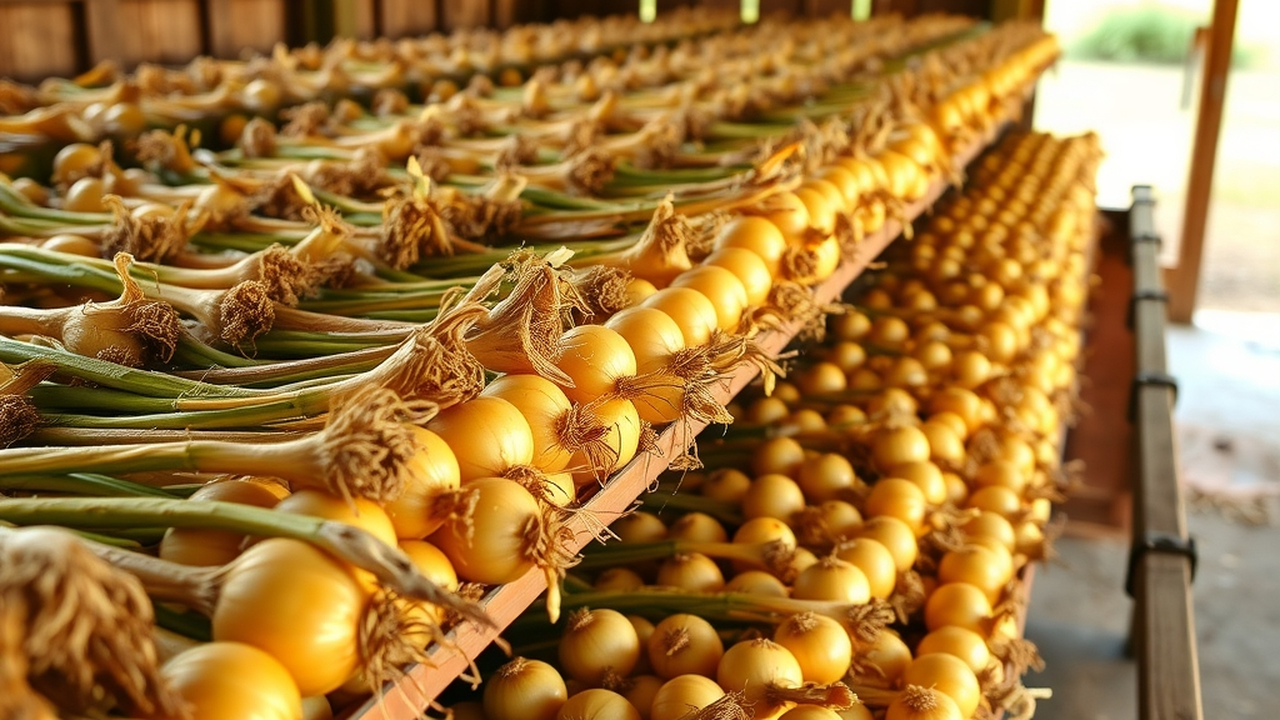
Move the whole plants — bulbs, tops, roots, everything — somewhere warm, dry, airy and out of direct sun: a covered porch, an open shed, a garage with the door cracked, screens or slatted racks laid across sawhorses. Single layer, not touching. Then leave them for two to three weeks while the magic happens: outer skins papering up into the crackly wrapper that is the storage container, and — the part that matters most — necks drying down to a sealed, papery close.
The done-test lives at the neck: roll it between your fingers — a cured neck is thin, dry and papery with no slip or give. A thick, soft, or damp neck is an open door to the bulb; those onions go to the kitchen pile, not storage. Same triage as every stored crop: flawless and sealed goes in; thick-necked, nicked, or bull-necked (the ones that sent up a flower stalk) gets eaten first.
After curing, trim roots to a stubble and either cut tops to ~3 cm above the neck — or don’t cut them at all, because:
The braid (storage method and wall art in one)
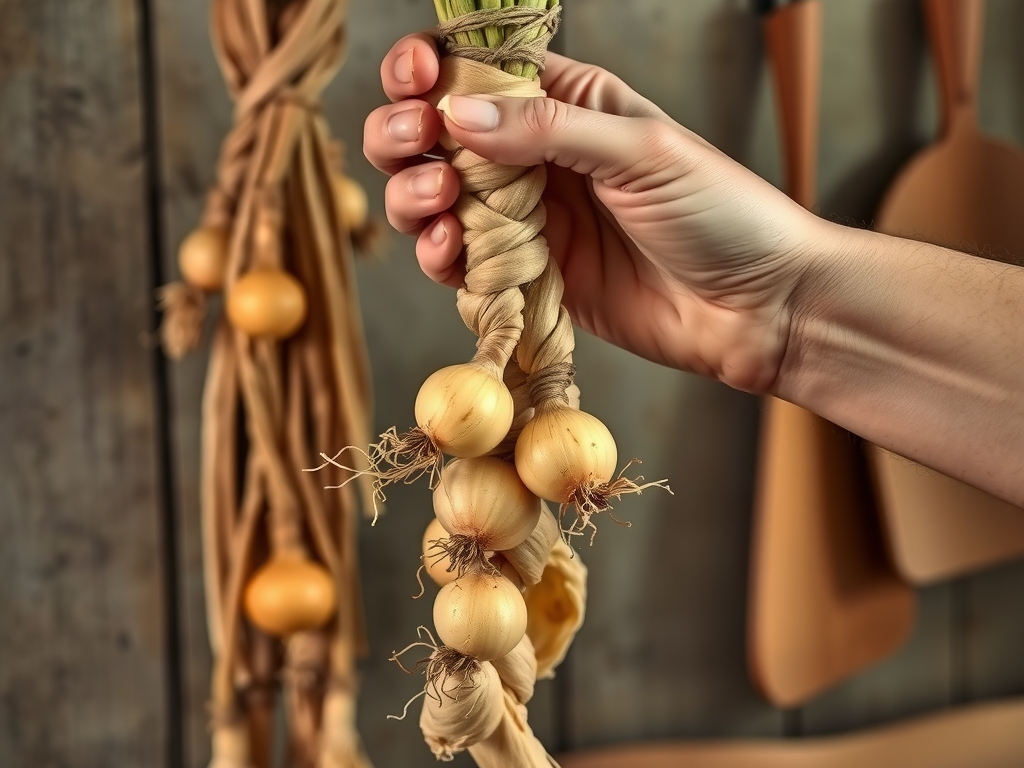
Braiding needs the tops left long, still slightly pliable (end of cure, not bone-dry). The method is three-strand hair-braiding with a twist: start with three onions, braid their tops together once, then add a new onion into the braid every crossover, weaving each new top into one of the three strands as you go. Keep it tight — the weight hangs on those dried tops — and finish with twine and a loop.
Why bother beyond the charm: a braid is maximum airflow storage (every bulb exposed, nothing touching in a pile), instant visual inspection (a softening onion shows itself), and grab-and-cut convenience — snip the bottom onion off the braid as needed. One braid of 12–15 onions on a cool pantry wall is a working month of cooking. If braiding isn’t your craft, mesh bags, old (clean) pantyhose with a knot between bulbs, or shallow slatted crates deliver the same airflow with less romance.
Storage: cool, dry, dark, airy — and the sweet-onion truth
Cured storage onions want 0–10°C, dry, dark, ventilated — the cool-and-dry crew’s corner, alongside the garlic and squash, never the humid sand-box zone and never the fridge (cold-humid turns onions soft; the fridge is only for cut halves). Keep them away from potatoes — the two trade moisture and gases and shorten each other — and expect 6–9 months from hard yellow storage varieties.
Now the truth most guides mumble: sweet onions don’t keep, and no technique changes that. The mildness you love in a Vidalia-type is high water content and low sulfur — the exact chemistry that makes an onion pungent is what preserves it. Sweets hold 3–6 weeks; treat them as a fresh-eating crop, and cure only your pungent storage varieties for the long haul. If your planting was all sweets, the surplus still has exits: chopped onions freeze perfectly well for cooking, and caramelized-then-frozen is the connoisseur’s move.
What works
- Wait for the natural flop, then one dry week in-ground before lifting
- Cure 2-3 weeks airy and shaded until necks roll thin and papery
- Braid or mesh-bag for airflow; snip from the braid as you cook
- Storage varieties keep 6-9 months; eat the thick-necked ones first
What doesn't
- Bending tops over by hand to rush the flop (bruised necks rot first)
- Washing bulbs or curing in direct sun (moisture in, green scald on)
- Expecting sweet onions to store (their chemistry forbids it - eat fresh)
- The fridge or the potato bin as onion storage (both end badly)
FAQ
How do I know when onions are ready to harvest?
The plants tell you: in late summer the tall tops weaken at the neck and flop over on their own — when half to three-quarters of a planting has fallen, bulbing is done. Stop watering, leave the bulbs in the ground one more week to thicken skins, then lift them gently with a fork on a dry day. Don’t bend tops over manually to hurry the process; it bruises the neck, which is precisely the seal that decides how long the onion keeps.
How long do onions need to cure before storing?
Two to three weeks somewhere warm, dry, airy and shaded — whole plants in a single layer on racks or screens. The finish line is the neck test: rolled between your fingers, a fully cured neck feels thin, papery and completely dry, with no soft slip. Onions with thick or soft necks after curing won’t store — route them to the kitchen. Curing is also when the outer skins paper up into the wrapper that protects the bulb for the months ahead.
What is the best way to store onions long term?
Cool (0–10°C), dry, dark and ventilated — a garage shelf, cool pantry or cellar’s dry corner — with air reaching every bulb: hanging braids, mesh bags, or shallow slatted crates, never sealed containers or plastic bags. Keep onions away from potatoes (they spoil each other) and out of the refrigerator, whose humid cold softens whole bulbs. Hard, pungent storage varieties handled this way keep six to nine months; check monthly and pull anything softening or sprouting.
Why won’t my sweet onions keep in storage?
Because the trait you bought them for is the problem: sweet, mild onions (Vidalia types and kin) are high in water and low in the sulfur compounds that both make onions pungent and preserve them. No curing technique overcomes that chemistry — sweets hold three to six weeks at best, so eat them fresh and save long storage for hard yellow keepers. A surplus of sweets isn’t wasted, though: chopped raw onion freezes well for cooking, and caramelizing before freezing turns the glut into instant soup and sandwich gold.
One flop, one cure, one braid on a nail — and the onion aisle becomes somewhere you wave at politely until spring.
Keep reading
guides
Root Cellar Without a Cellar: Store Months of Food With No Basement
No basement, no problem. Garage corners, buried barrels, sand boxes and in-ground trenches — honest ways to store potatoes, carrots, squash and apples for months.
guides
Fall Garden Cleanup: What to Remove, What to Leave (Most People Clean Too Much)
The honest fall checklist: pull the diseased and the pest hotels, leave the roots and the leaves — why a too-tidy garden costs you soil, pollinators, and next spring's head start.
guides
How to Plant Garlic in Fall: The 20-Minute Job That Feeds You Next July
Plant cloves in October, ignore them all winter, harvest heads in summer — the honest garlic guide: hardneck vs softneck, seed garlic vs grocery bulbs, spacing, and the one mistake that ruins it.